This section link is no longer available. Start from the first section.
Design a Scalable Notification System
Design a resilient multi-channel notification engine that isolates critical OTPs from marketing surges, enforces downstream provider quotas, and guarantees zero data loss across push, SMS, and email.
The problem and scope
Sending a notification seems straightforward: an event happens, and the server sends a message to a user’s phone or inbox.
In reality, three hard problems quickly emerge at scale:
- Critical alerts getting stuck behind marketing blasts: If the marketing team sends a 500,000-user promotional email at the exact moment someone is trying to log in, a single-file system will make the login code wait behind half a million discount flyers. A 30-second delay on an OTP means an abandoned login.
- Third-party delivery services slowing down or crashing: Your system doesn’t deliver messages directly to phones; it hands them off to external partners like Apple (APNs), Google (FCM), Twilio, or SendGrid. If an external partner slows down or experiences an outage, your servers can freeze waiting for a response, eventually crashing and losing unsent messages.
- Notification spam and buzzing lock screens: If five people like your photo in three seconds, your phone shouldn’t buzz five times. The system must group rapid-fire actions into a single summary, respect time zones so marketing doesn’t wake people at 3:00 AM, and drop alerts that are no longer relevant.
To solve this, the architecture is built around three rules: urgent alerts get a dedicated fast lane, messages are saved safely to storage before contacting external vendors, and delivery providers can be swapped or added without rewriting core logic.
System boundary and non-goals
- In Scope: The distributed pipeline between internal service triggers and third-party vendor handoff—including durable multi-AZ ingress, isolated priority queuing, template hydration, user preferences/quiet hours, burst debouncing, egress Token Bucket rate limiting, dual-tier retries, and click/receipt telemetry.
- Out of Scope (Non-Goals): Upstream domain trigger logic (deciding when an alert is needed), copywriting/creative design, payload end-to-end encryption, and telecommunication carrier networks.
Functional requirements
Core platform delivery operations
- Accept and dispatch notifications across channels. The system supports push (iOS via APNS, Android via FCM, and desktop via Web Push), SMS (via Twilio or equivalent), and email (via SendGrid or equivalent). The channel set is pluggable.
- Persist every accepted notification before dispatch. Once the system accepts a notification, it immediately saves it to durable storage before attempting delivery. If an external vendor (like Apple or Twilio) goes offline, the notification remains safely on disk for retry rather than being lost. Tracking database records are updated in the background so they never slow down urgent sends.
- Route by priority to isolated processing lanes. High-priority messages (OTPs, security alerts) route to dedicated topics separate from medium (transactional) and low (promotional) traffic with independent worker pools. A promotional surge must not starve critical OTPs.
- Retry failed deliveries via dual-tier mechanics. Transient failures retry via seconds-scale in-worker backoff for high-priority OTPs (before channel fallback) and Kafka delay topics for medium/low traffic; permanently undeliverable messages move to a Dead Letter Queue (DLQ) and the durable audit log.
- Support click callbacks. Every notification payload includes a callback URL. When the user taps the notification, the client fires a webhook to the tracking service, recording the click event against the notification ID.
- Group related notifications. Multiple rapid events of the same type for the same user (e.g., five likes in three seconds) collapse into a single summary notification rather than five separate alerts.
- Enforce user preferences and opt-outs. Before dispatch, the system checks per-user, per-channel opt-in status and drops messages the user has declined.
- Rate-limit per user and per tenant. The system enforces maximum notification frequency per user per channel and per-client API rate limits to prevent a noisy internal service from degrading the platform.
- Support scheduled and delayed delivery. A notification can specify a future delivery time. A scheduler polls for due messages and enqueues them.
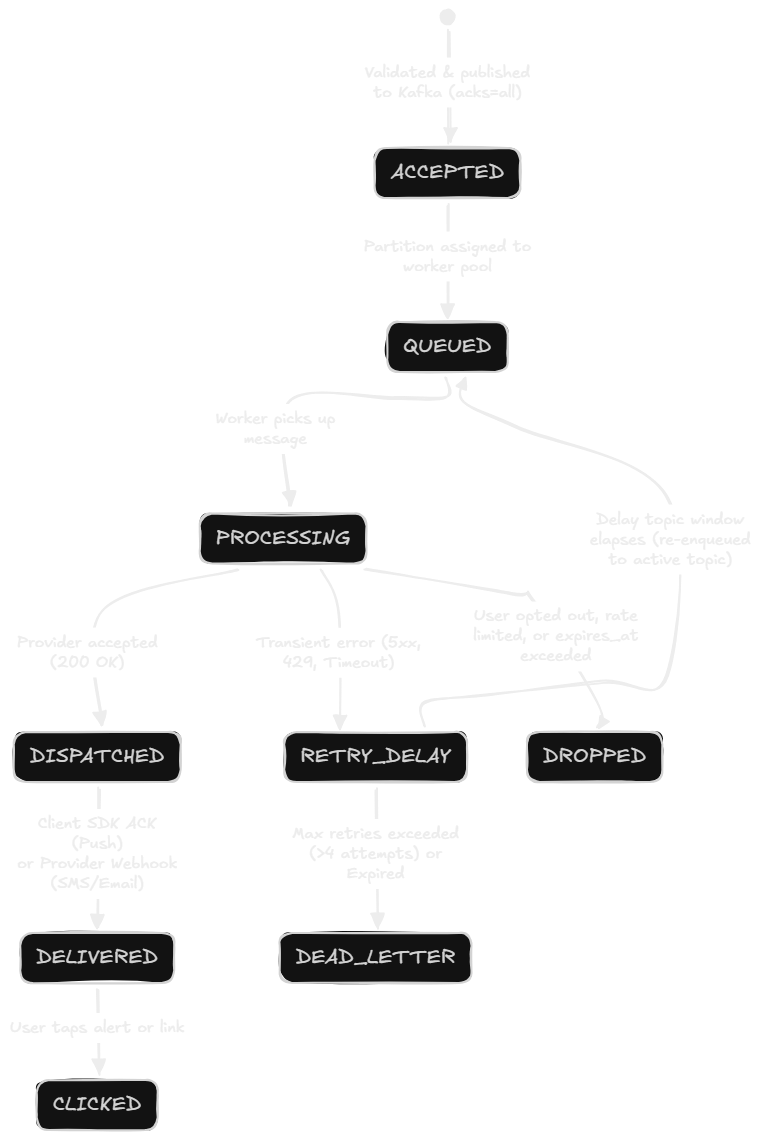
- Track delivery lifecycle. Each notification transitions through accepted → queued → dispatched → delivered → clicked (or failed), with each state change recorded for audit.
Non-functional requirements and assumptions
Operational benchmarks and availability boundaries
The following operational metrics establish target performance baselines for a multi-channel notification platform handling millions of daily events across transactional and promotional workloads.
| Property | Target | Rationale |
|---|---|---|
| Daily volume | 10M push, 1M SMS, 5M email (~16M total) | Reference-design assumption based on a mid-scale consumer platform. |
| Sustained throughput | ~185 notifications/second average | 16M / 86,400s. Not a raw QPS challenge. |
| Peak throughput | ~3,300/s during marketing bursts (5–10 min) | Promotional campaigns create short, intense surges. |
| Critical message latency | OTP handed to provider within 5s of acceptance (p99) | Platform handoff SLA; last-mile delivery depends on carrier networks and OS push sockets. |
| Transactional message latency | p95 < 30 seconds | Order confirmations, payment receipts. |
| Availability | 99.9% for the ingestion API | A down ingestion path silently drops business-critical messages. |
| Durability | Zero loss of accepted notifications | Replicated multi-AZ Kafka ingestion before acknowledging callers. |
| Consistency | At-least-once delivery | Retries across third-party boundaries can double-send; messages must be designed to be idempotent. |
| Idempotency | Deduplicate by (tenant_id, event_id) with type-scoped TTL | OTP replay window ~5–10 min; campaign replay window ~24 hr. |
| Security | Internal API locked by AppKey/AppSecret | Prevent external spam injection into the notification pipeline. |
The mental model and architecture
Four primitives that govern the design
-
Persist before dispatch (Zero-loss ingestion):
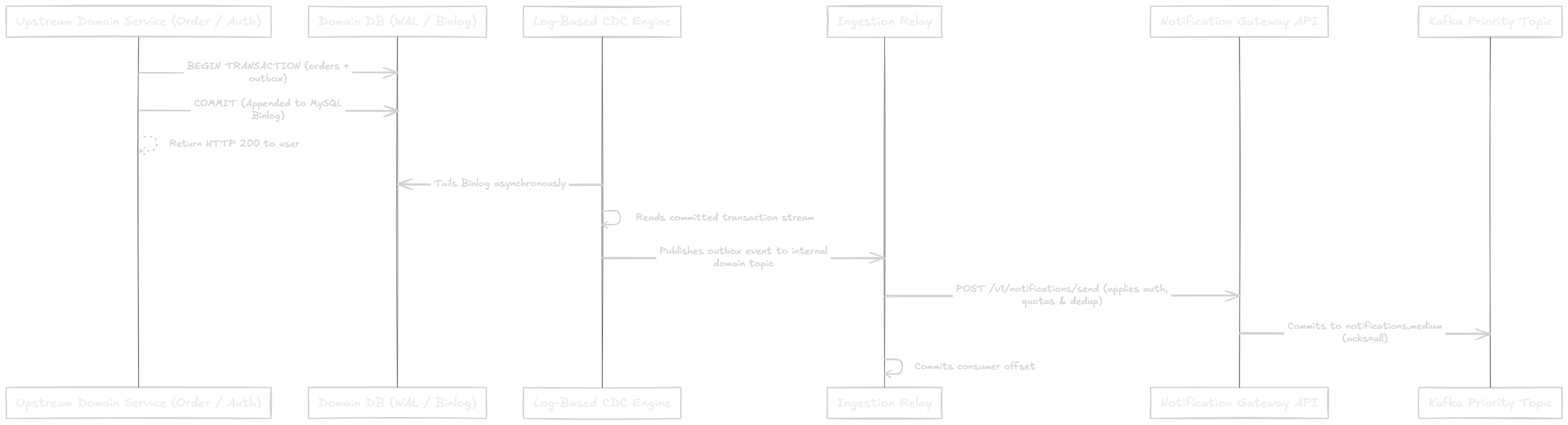
- Decoupled origin (Transactional Outbox): When a business event occurs (e.g., an order is placed), the upstream service saves an “outbox” record in its own database alongside the order. An async worker forwards this to the notification gateway. This guarantees the alert is never lost, without letting notification delays or failures impact the core business transaction.
- In-flight deduplication: The gateway tracks unique event IDs in a fast in-memory cache (Redis). If a duplicate request arrives while the first is still being processed, the gateway recognizes it and ignores it so the user never gets two identical messages.
- Confirm only after safe storage: The gateway writes the notification to a distributed message queue (Kafka) replicated across multiple servers. It only returns
202 Acceptedonce the message is safely saved to disk. If writing fails, the gateway clears the event ID from cache so the caller can retry immediately.
-
Physical priority isolation (Zero starvation):
- A single shared queue inevitably starves high-priority traffic during marketing surges. Architectural priority requires physical topic segregation over software priority flags.
- The platform routes validated notifications to three dedicated Kafka topics:
notifications.high/med/low. - Each lane runs independent consumer groups and isolated worker pools, guaranteeing promotional backlogs never delay OTP workers.
-
Egress rate shaping over vendor sockets:
- Internal workers consume tens of thousands of messages per second, but external providers enforce rigid account quotas (e.g., Twilio 100 SMS/second, SendGrid dedicated IP warmup limits, APNs stream caps).
- Unthrottled dispatches trigger HTTP 429 cascades or account suspensions. Dispatch workers enforce client-side Token Bucket rate limiters matched to vendor contracts, safely buffering bursts inside Kafka channel topics rather than overwhelming third-party sockets.
-
Bifurcated mobile payload contracts:
- Notification Messages (
title,body): Intercepted directly by the mobile OS system tray when backgrounded or killed; renders UI banners without waking app code. User taps launch the app and pass the payload. - Data Messages (custom key-value pairs): Delivered silently to the client background handler (
onMessageReceivedon Android) for background sync, cache pre-fetching, and badge updates without alerting the user. - Collapse & Offline Delivery: Payloads specify a Time-To-Live (TTL) and Collapse Key (
apns-collapse-idfor iOS,collapse_key/tagfor Android). If a device is offline during bursts, cloud gateways deliver only the latest update upon reconnection; on-screen banners update in place rather than stacking alerts.
- Notification Messages (
High-level architecture: The four-tier pipeline
The architecture decouples notification acceptance from third-party delivery across four tiers via a Two-Stage Topic Pipeline in Kafka:
- Ingestion & Durable Ingress: Stateless API validates schemas, derives priority and
expires_atstrictly server-side fromevent_typeand tenant policy (caller-supplied priority flags are ignored), acquires the Redis pending lease, and writes to Stage 1 Priority Topics (acks=all). High-priority traffic uses round-robin partitioning (nullkey) to maximize consumer thread saturation and eliminate head-of-line blocking. Bulk campaigns enter via an asynchronous Campaign Fan-Out Worker that chunks recipient batches directly intonotifications.lowin throttled increments to prevent gateway resource exhaustion. - Priority Queues & Processing Core: Consumes from Stage 1 topics by priority. Evaluates user channel opt-ins, quiet hours, and Redis debounce grouping before hydrating compact template variables into localized payloads.
- Channel Queues & Egress Dispatch Workers: Routes hydrated tasks to Stage 2 Channel Topics segmented by channel and priority (
channel.push/sms/email.high/med/low). Specialized workers apply the Adapter Pattern to translate payloads into vendor wire schemas, meter dispatches via Token Buckets to protect provider quotas (e.g., Twilio 100 SMS/s), and prune dead device tokens on provider feedback. Priority segregation ensures promotional push floods never head-of-line block OTP dispatches at the vendor socket. - Feedback, Delayed Retries & DLQ: Provider receipts and click beacons flow into an immutable Cassandra audit log. High-priority OTP failures execute fast in-worker retries before immediate SMS fallback; medium/low failures route through Kafka delay topics (
retry.1m/5m/15m/1h), with exhausted (>4 attempts) or expired records archived to the DLQ andNotification DB.
End-to-end system topology
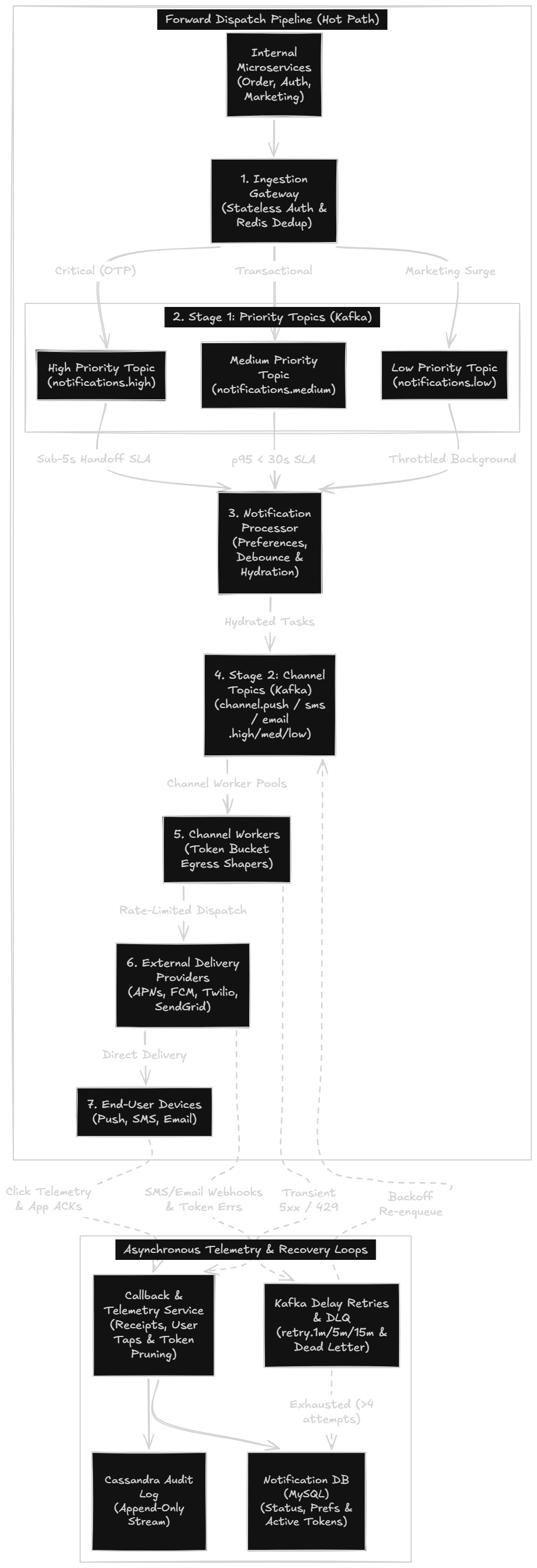
The topology is structured into a clean forward dispatch pipeline (the sub-5s hot path) and an out-of-band telemetry and recovery loop. The hot path flows strictly top-to-bottom, ensuring zero head-of-line blocking from asynchronous feedback or database writes.
-
The Forward Hot Path (Sub-5s Dispatch):
- Durable Ingestion: Ingestion returns
202 Acceptedonly after persisting to Kafka (RF=3,acks=all,min.insync.replicas=2), keeping the hot path off the relational database while guaranteeing multi-zone durability. - Two-Stage Priority Isolation: Stage 1 queues by urgency (
notifications.high/med/low). Stage 2 isolates channel adapters (channel.<type>.<priority>) with dedicated, over-provisioned worker pools so marketing surges never starve critical OTPs. - Egress Rate Shaping: Dispatch workers use token bucket limiters matched to vendor contracts (e.g., Twilio 100 SMS/s), buffering spikes in Kafka rather than triggering provider HTTP 429 cascades.
- Durable Ingestion: Ingestion returns
-
The Out-of-Band Loop (Recovery & Telemetry):
- Dual-Tier Retries: Transient OTP failures retry immediately in-worker before falling back to SMS; non-critical traffic cycles through Kafka delay topics. Stale messages drop via
expires_at, and exhausted retries move to the DLQ. - Asynchronous Telemetry: Delivery webhooks, device push ACKs, and click callbacks feed
Tracking Svc, updatingNotification DBstatus and appending immutable audit records to Cassandra without contending with active dispatches.
- Dual-Tier Retries: Transient OTP failures retry immediately in-worker before falling back to SMS; non-critical traffic cycles through Kafka delay topics. Stale messages drop via
Components and contracts
Service responsibility matrix
The following contract matrix outlines domain ownership, contracts, and failure containment across the architecture.
| Component | Owns | Receives | Returns / Emits | Failure behavior |
|---|---|---|---|---|
| Notification Gateway | Auth, schema validation, deterministic notification_id, Redis dedup claim | HTTPS requests from internal callers | Returns 202 Accepted + notification_id; publishes to Kafka Priority Topics (acks=all) | Returns HTTP 429 on abusive bursts; diverts authorized bulk surges to delayed intake; HTTP 400 on bad schema. |
| Notification DB (PostgreSQL / MySQL) | Lifecycle status, user preferences, device tokens, scheduled triggers | Async status events; scheduled registrations | Eventual status queries; scheduled triggers | Active tokens and preferences are cached in Redis with short TTLs so database failovers never stall in-flight OTP routing. |
| Priority Queues (Kafka) | SLA-isolated message buffering (notifications.high/med/low) | Events from Gateway and Fan-Out worker | Messages to Processor consumer groups | Replicated topics (RF=3, acks=all, min.insync.replicas=2) guarantee zero message loss. |
| Notification Processor | Resolves device tokens, fans out multi-device tasks, evaluates preferences, debounces bursts, hydrates templates | Messages from Priority Queues | Dispatches hydrated tasks to Stage 2 Channel Queues | Thread pools scaled by priority lag; diverts rate-limited bulk traffic to delayed topics. |
| Channel Queues (Kafka) | Channel- and priority-segregated buffering (channel.<channel>.<priority>) | Hydrated payloads from Processor | Tasks to Channel Workers | Physical separation prevents provider latency swings from cross-blocking lanes. |
| Rate Limiter & Debounce Cache | Tenant quotas, frequency caps, debounce buffers (Redis) | Key lookups and increments | Pass/drop flags; consolidated batch payloads | In-memory execution (<1ms); sliding window counters and Sorted Set timers. |
| Preference Gateway | User channel opt-ins, quiet hours | Preference queries from Processor | Channel routing set; quiet-hour status | Drops opted-out alerts; parks non-critical quiet-hour messages in Redis. |
| Template Registry | Storage of templates (HTML, plain text, push JSON) | Template IDs and dynamic variables | Hydrated, localized message strings | Falls back to default locale on missing translation dictionary. |
| Channel Workers (Adapter Pattern) | Translates internal payloads into 3rd-party vendor-specific payloads (e.g., APNs HTTP/2, Twilio SMS, etc.), binds notification_id into vendor callback parameters (StatusCallback), shapes egress traffic via token buckets, and prunes dead device tokens | Hydrated tasks from Channel Queues | 3rd-party provider API calls; delivery status events to Kafka | Fast in-worker retry (single 500ms backoff) for High lane before SMS fallback; throttles on provider quotas. |
| External Providers | Push, SMS, Email delivery (APNs, FCM, Twilio, SendGrid) | Payloads from Channel Workers | Delivery receipts to Callback Service | Decoupled via async workers; subject to egress rate limiters. |
| Tracking & Callback Svc | Ingestion of delivery receipts and recipient taps | Webhook callbacks and client tap beacons | Updates Notification DB; streams to Cassandra | Idempotent by (notification_id, action); redirects browser clicks to deep links. |
| Cassandra Audit Trail | Immutable historical audit log | Events from Tracking Service and Workers | Audit records in Cassandra | Passive consumer; lag does not block live notification dispatch. |
| Dual-Tier Retry Engine & DLQ | Transient failure retries and dead-letter parking | Failure events from Channel Workers | High lane: fast in-worker retry + SMS fallback; Med/Low: Kafka delay topics | Moves exhausted attempts (>4) or expired alerts to DLQ and updates DB status. |
The Transactional Outbox: where it belongs in the architecture
A common architectural trap is placing an outbox database inside the notification gateway itself. In a scalable design, domain services and the notification platform have strictly separated responsibilities:
- Upstream Domain Services (Owns the Outbox): Services like Order or Billing commit their business record and an
outboxevent in a single local ACID transaction. A log-based Change Data Capture (CDC) tailer relays these events to the notification gateway, eliminating dual-write loss without letting notification latency affect the business flow. - The Notification Gateway (Stateless Ingress): The gateway does not write to a database outbox. Putting a relational database in front of Kafka creates an ingestion bottleneck and polling lag for critical OTPs. Instead, the gateway verifies the payload and streams directly to Kafka (
RF=3,acks=all,min.insync.replicas=2) for sub-20ms multi-AZ durability before returning202 Accepted.
Technology choices
Message broker: Kafka for priority topics
Pressure: High write bursts, zero-loss persistence, event replay for debugging, and hard worker pool isolation across priority lanes.
| Option | Strengths | Trade-offs |
|---|---|---|
| Kafka (chosen) | High-throughput partitioned streaming, durable replay, sub-millisecond produce latency. | Operational complexity; lacks native per-message delays (requires delay topics). |
| AWS SQS | Serverless, zero maintenance, native 15-minute message delays. | No event replay; higher per-message latency than persistent streaming connections. |
| RabbitMQ | Native message priorities, flexible exchange routing. | Complex partition replay; requires quorum queues to match Kafka-level durability. |
Decision: Kafka serves as the backbone across three physical topics (notifications.high/med/low). Dedicated topics provide physical consumer group isolation so promotional blasts cannot starve OTP workers. (At extreme scale, isolate the High lane onto dedicated broker clusters to eliminate disk and network I/O contention from bulk campaigns).
Metadata and lifecycle state: Relational database (PostgreSQL or MySQL)
Pressure: User device tokens, opt-in preferences, templates, and scheduled delivery timers require indexed relational queries, while clients need a queryable status endpoint.
Decision: A relational database serves strictly as the domain metadata and status store. It manages registered hardware tokens, preferences, templates, and scheduled timers. It is never on the hot ingestion path: Kafka acts as the high-speed write buffer, while background consumers update database delivery statuses (ACCEPTED → DISPATCHED → DELIVERED) asynchronously in batches.
Rate limiting, deduplication, and egress shaping: Redis
Pressure: Ingress rate limiting, deduplication checks, and outbound token buckets execute on every notification and must complete in sub-milliseconds to protect the sub-5-second hot path.
Decision: Redis is chosen for high-throughput, in-memory atomic operations across three hot-path concerns:
- Rate limiting: Sliding-window counters enforce per-user frequency caps and per-tenant ingress limits.
- In-flight deduplication: Event-scoped idempotency keys (
SET ... NX EX) catch duplicate retries at both the ingress gateway and worker dispatch boundaries before duplicate messages can be published or sent. - Egress rate shaping: Token bucket counters meter outbound traffic to match third-party provider quotas (e.g., Twilio 100 SMS/s) with atomic decrements.
Audit trail: Cassandra
Pressure: Delivery lifecycle events are append-only, high-volume writes that must not contend with transactional logs.
Decision: A Cassandra cluster serves as the append-only audit trail. A passive consumer tails dispatch Kafka topics and writes immutable records, completely isolating analytical writes from the primary delivery path.
Template engine: In-process library
Pressure: Passing fully rendered HTML for millions of queued notifications wastes network bandwidth.
Decision: Queued messages carry compact event variables and a template_id. The in-process template engine hydrates the payload and applies localization immediately before vendor dispatch.
How the system works
The end-to-end dispatch flow
This sequence traces a single OTP notification from ingestion through delivery, highlighting queue decoupling, policy enforcement, template hydration, and provider egress token checks.
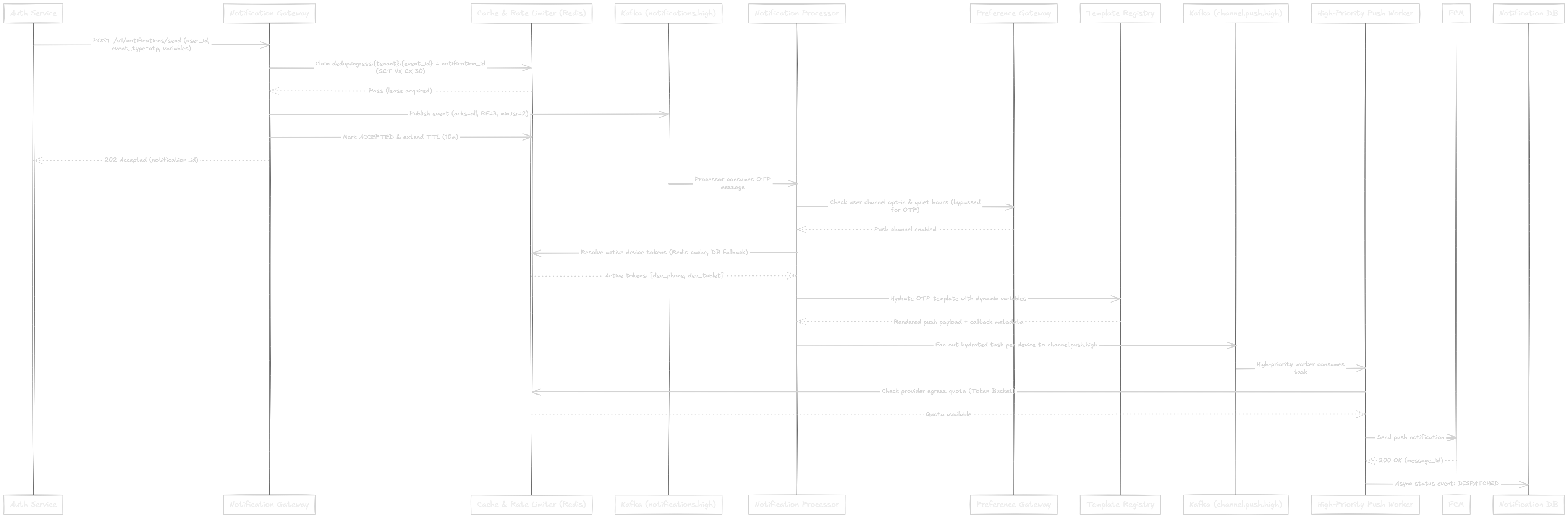
- The Auth Service receives
202 Acceptedwithin single-digit to low tens of milliseconds — it never waits for FCM or a relational database write. - The Gateway claims a pending deterministic
notification_idin Redis before publishing and finalizes it upon Kafka confirmation, preventing concurrent double-enqueueing while ensuring caller retries receive the original ID. - The OTP is classified as High priority and published to
notifications.highwithacks=all, bypassing any promotional backlog innotifications.low. - The Processor resolves active device tokens from Redis cache (backed by the relational database) and fans out one dispatch task per registered device into
channel.push.high. - Dedicated worker pools drain
channel.push.highwith bounded in-flight concurrency, ensuring urgent alerts are never head-of-line blocked behind bulk promotional pushes inchannel.push.low. - The worker verifies provider egress rate limits (token bucket) before dispatch, protecting vendor socket quotas.
Priority routing to distinct topics
The priority classifier runs during the Validation stage, mapping event_type to a priority level using a configurable rules table. The following allocation matrix defines the routing rules, target Kafka topics, and latency SLAs across priority tiers.
| Priority Tier | Target Kafka Topic | Example Event Types | SLA & Consumer Allocation |
|---|---|---|---|
| High | notifications.high | otp_login, password_reset, fraud_alert, wire_transfer | Provider handoff < 5 seconds; dedicated over-provisioned worker pool. |
| Medium | notifications.medium | order_confirmed, payment_receipt, shipment_out_for_delivery | Provider handoff < 30 seconds; auto-scaled worker pool based on lag. |
| Low | notifications.low | flash_sale, weekly_newsletter, price_drop_digest | Best-effort (minutes to hours); throttled during peak hours. |
Each priority topic operates with dedicated consumer groups and independently scaled worker pools. The High lane is deliberately over-provisioned: even if marketing events flood notifications.low with 100,000 messages during a flash sale, the High lane’s consumer threads remain idle and instantly process arriving OTPs without head-of-line blocking.
Dual-tier retry architecture: Kafka delay topics and DLQ
When third-party providers fail (HTTP 503s, 429 rate limits, or socket timeouts), retries are bifurcated by priority.
Instead of traditional database retry tables—where polling WHERE next_retry_at <= NOW() creates connection spikes, table locks, and multi-hour recovery lag after outages—the platform offloads transient retries to Kafka delay topics. Because every message in a bucket shares an identical delay, partition heads remain strictly chronological, allowing workers to drain retries at streaming scale without touching the database.
- High-Priority (Fast In-Worker Retry + Fallback): OTPs expire quickly and cannot wait in delayed queues. Workers enforce a strict 1.5s provider socket timeout, allow a single 500ms jittered retry, and immediately trigger secondary channel fallback (Push → SMS), completing vendor handoff within ~3.7 seconds.
- Medium & Low-Priority (Kafka Delay Topics): Non-critical messages route through bucketed delay topics (
notifications.retry.1m/5m/15m/1h), safely absorbing massive provider backlogs without database contention. - Dead-Letter Queue & Expiration: Before any dispatch attempt, workers verify
expires_at > now(), silently dropping stale alerts. Exhausted retries (>4 attempts) publish tonotifications.dlqand recordDEAD_LETTERinNotification DBfor operator alerts and replay scripts.
High-priority latency budget under failure
The following latency budget maps worst-case execution during a primary provider outage, demonstrating how the sub-5-second SLA is preserved:
| Pipeline Step | Nominal Latency | Worst-Case Failure Latency | Failure Handling Behavior |
|---|---|---|---|
| Ingestion & Ingress Dedup (Gateway) | 10–20ms | 50ms | Fallback to at-least-once ingestion if Redis slow |
| Stage 1 Queue Buffering (Kafka) | 5–15ms | 50ms | Partition leader failover / producer backoff |
| Notification Processor & Prefs | 10–30ms | 60ms | In-memory Redis cache with fallback |
| Stage 2 Channel Queue (Kafka) | 5–15ms | 50ms | Consumer pickup on dedicated high lane |
| Push Dispatch Attempt 1 (FCM/APNs) | 150–400ms | 1,500ms | Socket timeout triggers fast retry |
| Fast In-Worker Retry (Push) | — | 500ms | Single retry; failure triggers immediate fallback |
| Channel Fallback Dispatch (SMS) | 300–800ms | 1,500ms | Handoff to secondary provider (Twilio) |
| Total Provider Handoff | ~500–800ms | ~3,710ms (< 5s SLA) | Preserves SLA even during primary push outage |
Click and engagement callback tracking
Tracking mechanics diverge fundamentally between browser links and native mobile applications:
- Email & SMS (HTTP 302 Redirect): Outbound links are wrapped with a tracking endpoint (
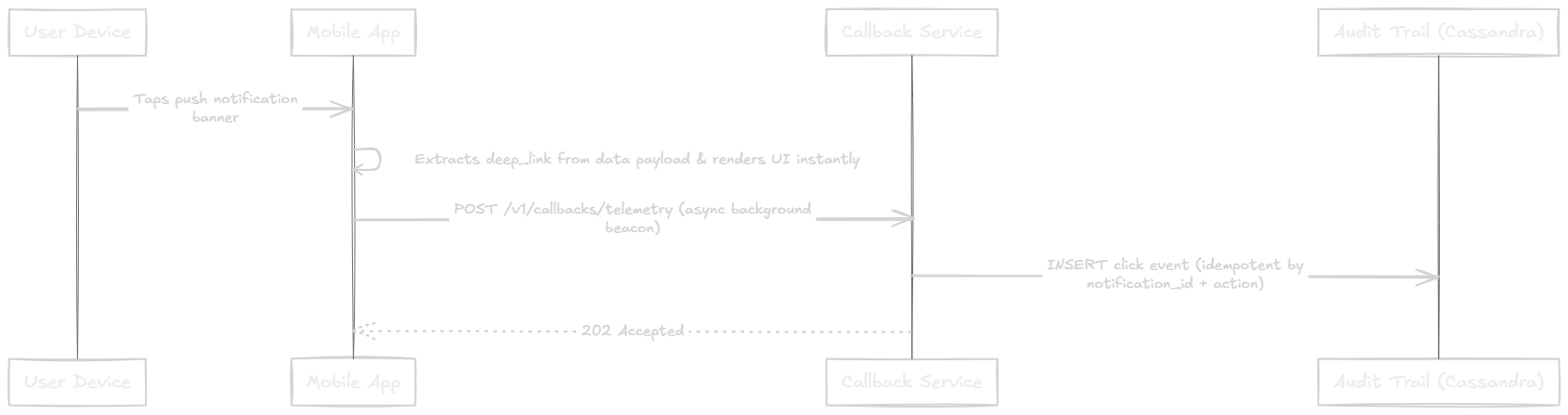
GET /v1/callbacks/:id?redirect=<url>). When clicked, the service logs the event to Cassandra and immediately issues an HTTP 302 redirect to the destination. - Mobile Push (Deep-Link First + Async Beacon): Tapping a banner must never block on network redirects. The native OS extracts deep-link parameters directly from the payload dictionary to render the target screen instantaneously. The client SDK then fires an out-of-band telemetry beacon (
POST /v1/callbacks/telemetry) to Cassandra without introducing UI latency.
Notification grouping and debounce
When high-velocity interactions occur (e.g., multiple likes on a photo within seconds), sending individual push notifications causes alert fatigue. The platform collapses rapid bursts using a two-tier strategy:
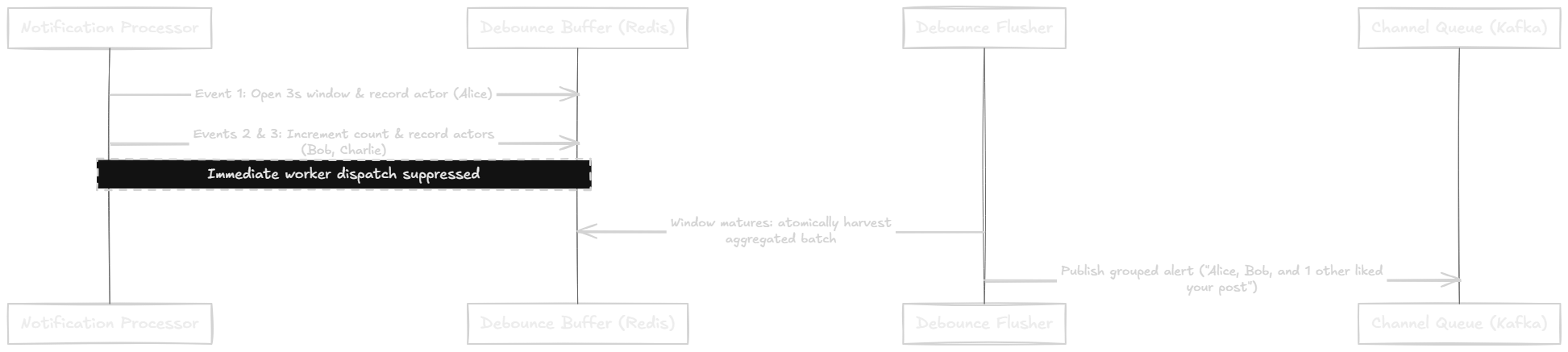
- Backend Aggregation (Redis Sorted Sets):
- Open window: The initial event opens a short window (e.g., 3s), storing actor IDs in a Redis hash and registering maturity (
now() + 3s) in a Sorted Set (debounce:active_windows). - Coalesce: Subsequent events within the window increment counters and append actors without triggering dispatches.
- Flush: Background workers poll mature windows (
ZRANGEBYSCORE), atomically extract the batch via a Lua script, and publish a single summary alert (“Alice and 4 others liked your photo”) to Stage 2 Kafka topics.
- Open window: The initial event opens a short window (e.g., 3s), storing actor IDs in a Redis hash and registering maturity (
- Client-Side Banner Collapsing: Push payloads include an OS collapse key (
apns-collapse-idfor iOS,tagfor Android). If alerts reach the device close together, the mobile OS updates the existing banner in place rather than stacking cards on the lock screen.
Data model
The data model decouples global user identity from transient hardware device tokens, and isolates delivery attempt records to maintain an immutable audit trail.
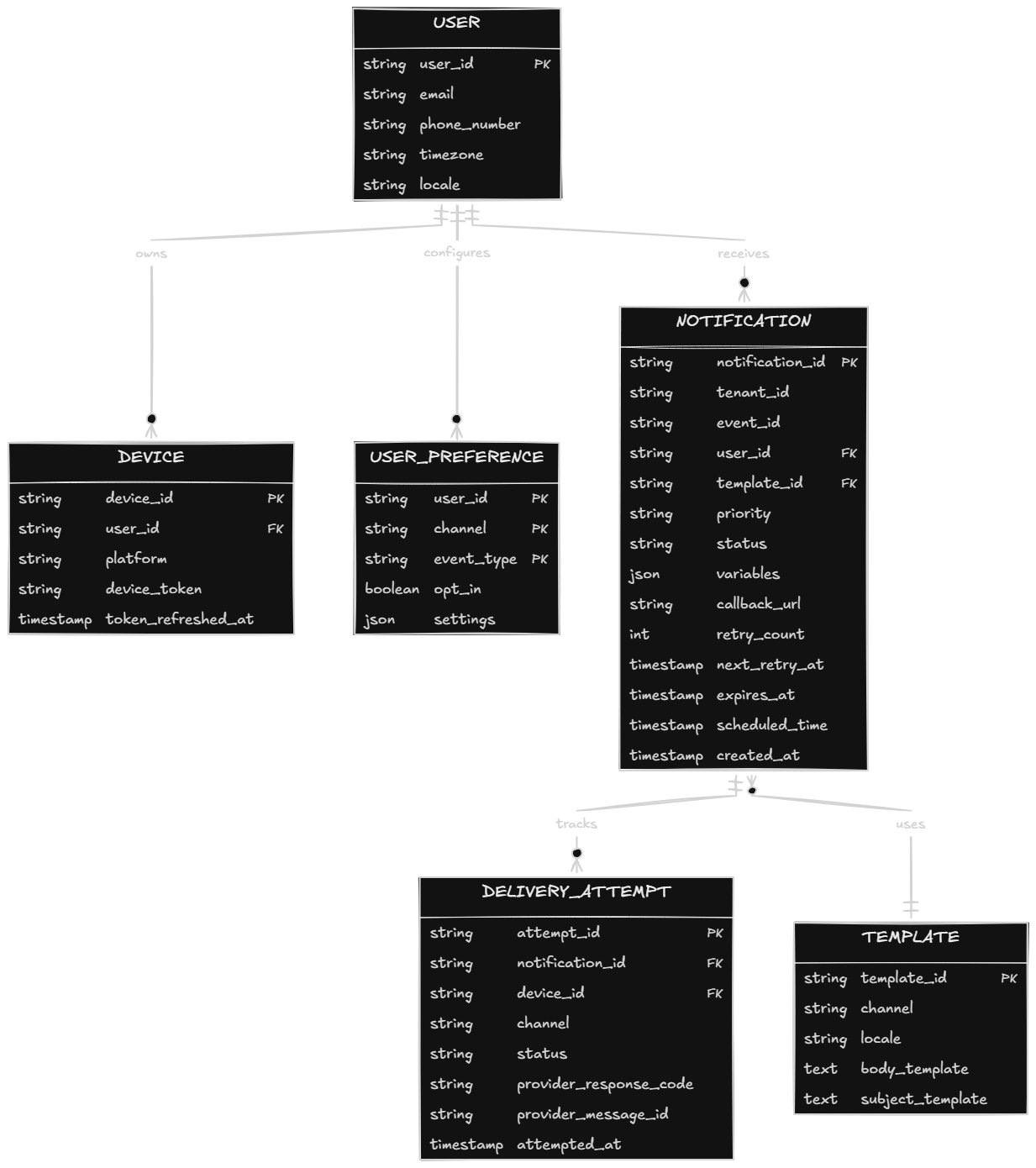
NOTIFICATIONrepresents the logical accepted event with unique constraint(tenant_id, event_id).DELIVERY_ATTEMPTtracks each individual physical dispatch per device and channel.NOTIFICATION.expires_atprevents delivering stale alerts; workers drop any task whereexpires_at < now().NOTIFICATION.retry_countandnext_retry_atare asynchronous audit fields written by status consumers, not polled for queuing. Active retries flow strictly through Kafka delay topics.DEVICE.device_tokenis ephemeral. A token refresh webhook updates this field when APNS or FCM rotates the token.USER_PREFERENCEstores granular opt-in by channel and event type. The preference gateway checks this before dispatch.NOTIFICATION.scheduled_timesupports delayed delivery. The Scheduler queries rows wherescheduled_time <= NOW()andstatus = 'ACCEPTED'.
API contract
The gateway exposes an asynchronous REST interface authenticated via service credentials (AppKey/AppSecret) and protected by idempotent event tracking:
| Method & Route | Purpose | Key Contract | Response |
|---|---|---|---|
POST /v1/notifications/send | Ingest transactional or priority notification | event_id, user_id, event_type, variables, optional redirect_url | 202 Accepted (notification_id, status) |
POST /v1/campaigns | Ingest bulk marketing campaign | segment_id, template_id, scheduled_time, target channels | 201 Created (campaign_id, status) |
GET /v1/notifications/:id/status | Query delivery lifecycle state | notification_id | 200 OK (eventually consistent) |
GET /v1/callbacks/:id | Web/SMS redirect tracker | notification_id, query param redirect | 302 Found (redirects to destination) |
POST /v1/callbacks/telemetry | Native mobile push tap beacon | notification_id, action, device_id | 204 No Content |
PUT /v1/devices/token | Register or update push token | user_id, platform, device_token | 200 OK |
Ingestion schema (POST /v1/notifications/send)
Security rule: Priority is derived strictly server-side from
event_typeand tenant policy. Caller-supplied priority parameters are ignored to prevent marketing jobs from hijacking high-priority OTP lanes.expires_atdefaults automatically per event type (e.g., 10 minutes for OTPs).
{
  "event_id": "evt-a1b2c3d4",
  "user_id": "usr-9876",
  "event_type": "otp_login",
  "variables": {
    "otp_code": "482901"
  },
  "redirect_url": "myapp://login"
}
Response (202 Accepted):
{
  "notification_id": "ntf-xyz-789",
  "event_id": "evt-a1b2c3d4",
  "status": "ACCEPTED",
  "created_at": "2026-11-01T12:00:00Z"
}
Bulk campaign fan-out and off-hours traffic shaping
When internal marketing teams launch promotional campaigns targeting millions of users, an unconstrained blast risks exhausting vendor rate limits or triggering checkout rushes. The system enforces two operational safety controls:
- The Campaign Fan-Out Engine: Marketing services register a single campaign via
POST /v1/campaignsspecifyingsegment_id,template_id, andscheduled_time. Dedicated Fan-Out Workers query the user database using keyset-paginated cursor batches (e.g., 5,000 users per chunk), generate lightweight notification records, and enqueue them directly intonotifications.lowin throttled increments. - Off-Hours Traffic Shaping: Bulk promotional jobs are scheduled to run exclusively during regional off-peak hours (e.g., 10:00 AM to 4:00 PM local user time), preventing large batches from contending with peak evening transactional commerce traffic.
The hardest design choices
Deduplication TTL scoping: OTPs vs. bulk campaigns
The pressure: Deduplication TTLs must match the caller’s plausible retry window without exhausting Redis memory:
- OTPs (10-minute TTL): Matches user authentication timeout. Keeping keys longer wastes memory on transient codes that can never be reused.
- Bulk Campaigns (24-hour TTL): A crashed fan-out worker can restart hours later and replay an entire batch of 200,000 recipients.
- Decision: Keys are scoped by tenant and event:
dedup:ingress:{tenant_id}:{event_id}with type-specific TTLs. On duplicate hits, the gateway returns the originalnotification_id(202 Accepted) without re-enqueueing.
Rate-limit breaches: Outright drops vs. delayed queue routing
The pressure: When an internal service or campaign breaches its rate quota, returning 429 Too Many Requests creates failed business events and caller retry storms. Conversely, admitting bursts into real-time queues breaches the sub-5-second OTP SLA.
Decision: The platform applies dual-policy enforcement based on traffic origin:
- Abusive or unauthenticated traffic: Rejected immediately with
HTTP 429 Too Many Requests. - Authorized internal bursts: Diverted into a bounded
notifications.delayedtopic with an explicit expiration. A throttled consumer drains this topic during off-peak windows, guaranteeing eventual delivery without degrading transactional lanes.
Design deep dives
Quiet hours, timezone awareness, and digest modes
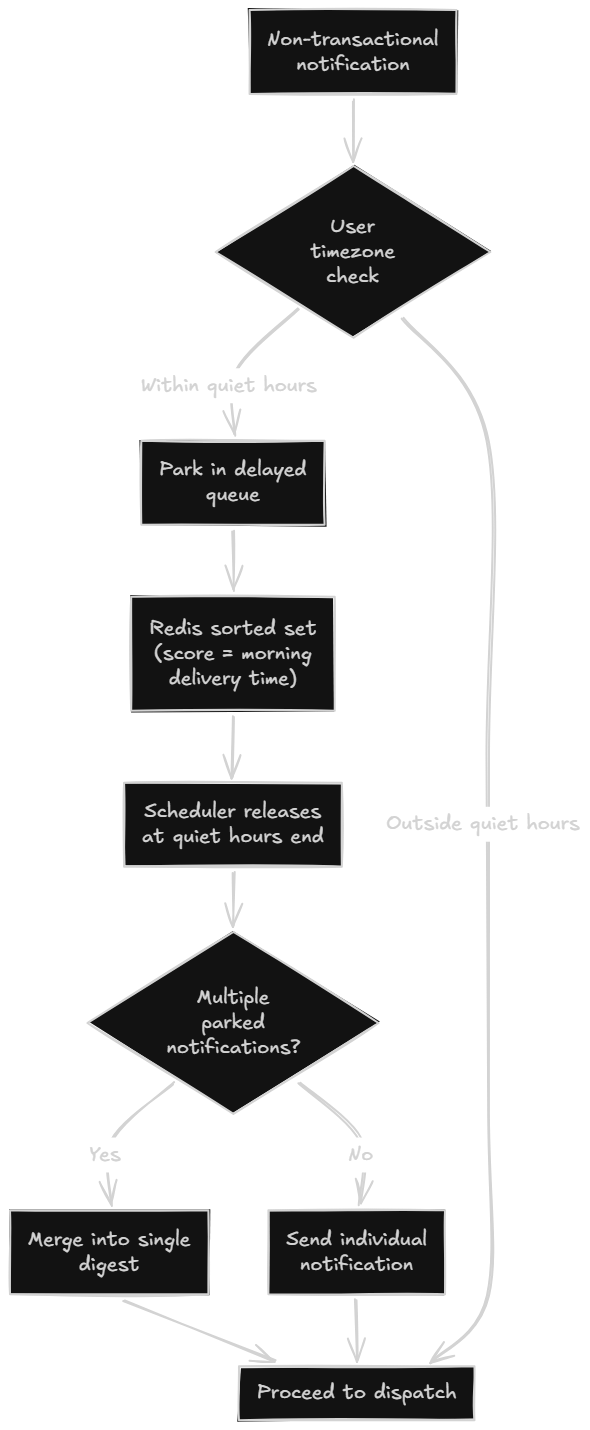
A marketing push notification at 3:00 AM in the user’s timezone degrades retention. Non-transactional alerts evaluate the recipient’s local timezone, parking overnight notifications in Redis Sorted Sets before releasing them as a consolidated morning digest.
- The
USER_PREFERENCEtable stores user quiet hours and delivery preferences in a flexible JSONsettingscolumn. - Non-transactional notifications that arrive during quiet hours are parked in a Redis sorted set with the score set to the user’s next morning delivery time. Transactional messages (OTPs, security alerts) bypass quiet hours.
- When quiet hours end, the scheduler releases parked messages. If multiple messages accumulated, the digest mode merges them into a single summary notification.
Channel fallback and geo-routing
When primary push delivery fails or times out, the system avoids blind retries. The fallback decision tree balances delivery SLAs against telecom costs:
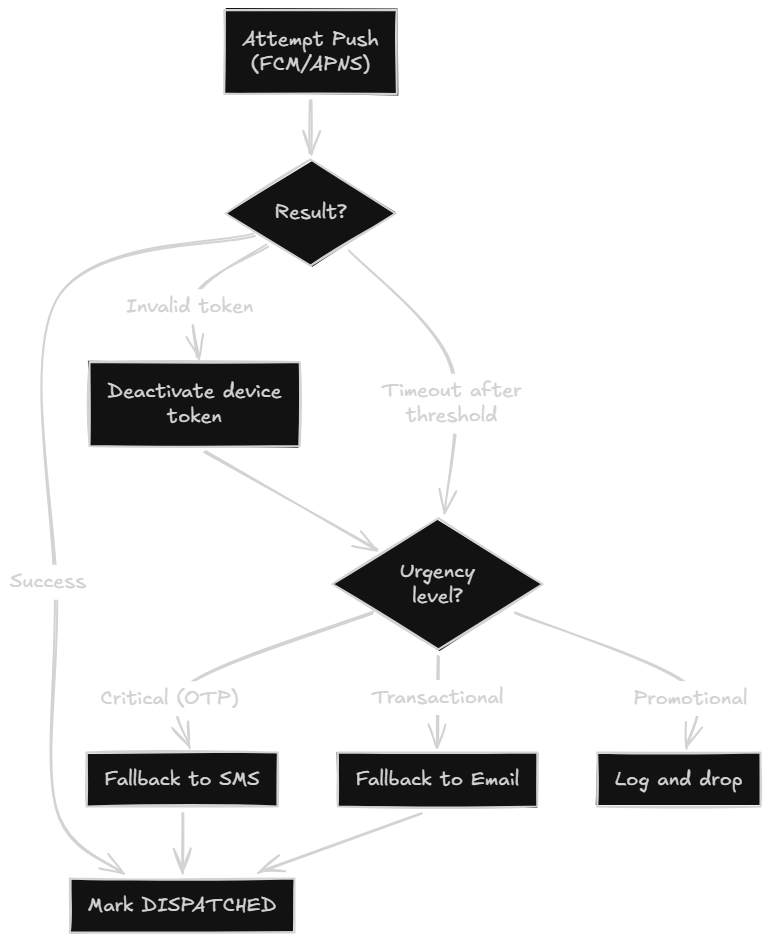
- Sequential Fallback vs. Cost Containment:
- Critical OTPs: Use sequential fallback (Push → SMS after timeout) to guarantee delivery within 5 seconds. Simultaneous multi-channel broadcast is reserved strictly for account security emergencies.
- Promotional alerts: Push failures are logged and dropped—never falling back to SMS due to prohibitive carrier costs ($0.01–$0.05/SMS).
- Dead Token Invalidation Loop: Workers deactivate device tokens (
DEVICE.is_active = FALSE) only on explicit unregistration responses (APNs410 Unregistered, FCM404 UNREGISTERED). This prevents future marketing blasts from wasting millions of calls on dead tokens. Schema bugs (400 InvalidArgument) trigger alerts without deactivating devices. - Geo-Routing for Regional Push: Where global push gateways are restricted (e.g., Google FCM in mainland China), the adapter routes notifications to regional OEM push gateways (e.g., Xiaomi, Huawei) based on device metadata.
Outbound provider egress rate limiting and traffic shaping
Downstream egress shaping prevents third-party API throttling (HTTP 429) and account suspension by metering dispatch calls to vendor contracts. Channel Workers implement this via three distributed coordination patterns:
- Isolated Priority Reservoirs: Egress quotas are partitioned across priority lanes (e.g., reserving 20 SMS/s for
channel.sms.highout of a 100 SMS/s Twilio quota). Marketing surges inchannel.sms.lowcan buffer safely in Kafka, but can never starve instantaneous OTP dispatches. - Batched Token Leases (Redis Lua): Rather than having hundreds of distributed worker pods execute per-message round-trips to Redis, workers claim token leases in blocks (e.g., 10 tokens for a 1-second window) via an atomic Lua script, draining them locally to eliminate network latency.
- Non-Blocking Partition Polling: Calling
consumer.pause()when vendor quotas are exhausted causesmax.poll.interval.mstimeouts, rebalance storms, and blocks unrelated tenants on the same partition. Instead, workers maintain active polling and divert quota-exceeded tasks to delay topics (channel.sms.throttled) or an in-memory delayed ring buffer.
Asynchronous DB updates via event streams
A peak burst of 3,300 notifications/s generates 6,000–10,000 lifecycle events/s as messages transition across states (QUEUED → SENT → DELIVERED or FAILED). Writing these synchronously back to the primary database would instantly exhaust connection pools and lock table rows.
Channel workers instead emit delivery status events to a dedicated notification-status-events Kafka topic. A dedicated batch consumer reads these events in micro-batches (500 records or 100ms windows) and executes bulk UPSERTs into PostgreSQL (for current lifecycle status) and bulk appends into Cassandra (for the immutable audit trail). This completely decouples worker dispatch throughput from database write latency.
Scale and capacity
Back-of-the-envelope calculations
Assumptions: 10M push + 1M SMS + 5M email = 16M notifications/day. Average payload size 500 bytes. Notification DB row ~200 bytes. Retention: 90 days for active notifications, indefinite for audit trail. The following capacity matrix outlines daily event volumes, ingress throughput, and storage growth across the platform.
| Dimension | Arithmetic | Result |
|---|---|---|
| Sustained write throughput | 16M / 86,400s | ~185/s |
| Peak write throughput | Marketing burst at ~18× sustained | ~3,300/s for 5–10 minutes |
| Kafka ingress bandwidth | 3,300/s × 500 B | ~1.65 MB/s (trivial for Kafka) |
| Notification DB storage (90 days) | 16M × 200 B × 90 | ~288 GB |
| Audit trail growth (monthly) | 16M × 300 B × 30 | ~144 GB/month (Cassandra handles easily) |
| Redis dedup key memory | 16M keys × ~50 B average | ~800 MB (within a single Redis node) |
| Device token table | 50M devices × 200 B | ~10 GB |
Limiting resource: This system is not bottlenecked by raw QPS. The architectural challenge is traffic isolation — preventing a promotional burst from starving OTPs — and provider resilience — surviving a Twilio outage without losing accepted notifications.
Failure modes and recovery
Failure mitigation matrix
The following operational playbook outlines automated mitigation pathways for component failures across the notification ingestion, queuing, and delivery lifecycle.
| Failure | Impact | Mitigation | Residual risk |
|---|---|---|---|
| Notification DB primary crash | Status queries and scheduled job checks temporarily pause. | Ingestion continues uninterrupted via Kafka. Automated failover promotes standby replica (< 30s). Active preferences and device tokens are cached in Redis with short TTLs so in-flight OTP dispatches continue without stalling. Async status batch consumer buffers in Kafka until DB is back. | Brief delay in dashboard status updates and scheduled releases. |
| Kafka broker failure | Partitions on failed broker temporarily unavailable. | Multi-broker replication (RF=3, acks=all, min.insync.replicas=2, unclean.leader.election.enable=false). Partition leader failover completes within seconds; producer retries with backoff. | Transient sub-second publication latency spike. |
| Redis failure | Rate limiting and fast dedup checks unavailable. | Fall through: accept notifications into Kafka to preserve availability. Redis Cluster with multi-zone replicas for HA. During downtime, workers operate in at-least-once mode without in-memory dedup. | Brief window of potential duplicate queue processing under concurrent client retries; downstream messages must be idempotent. |
| Third-party provider outage (Twilio down) | SMS delivery fails for all messages. | High-priority messages execute a single fast in-worker retry (500ms) with a 1.5s socket timeout and immediately fall back to secondary channels (e.g., Push/Email). Medium and Low messages retry via Kafka delay topics (retry.1m, retry.5m, retry.15m, retry.1h). DLQ and DB status update for permanently exhausted messages. | SMS delayed until provider recovers or fallback succeeds. |
| Provider quota throttling (HTTP 429) | Provider returns rate limit errors under burst. | Channel workers enforce token bucket traffic shaping before calling APIs. Excess load buffers safely in Stage 2 Kafka channel topics without dropping. | Increased delivery latency for low-priority bulk campaigns during peak surges. |
| Worker pool exhaustion | Messages accumulate in Kafka; consumer lag grows. | Auto-scaling worker pools based on consumer lag metrics (bounded by Kafka partition counts). Channel workers employ asynchronous, non-blocking HTTP/2 clients (e.g., Netty) with bounded in-flight concurrency, committing Kafka offsets only after provider handoff completes. | Transient delivery delay for medium/low priority messages proportional to burst size. |
SLA-centric observability
Aggregate metrics (CPU, total queue lag) are misleading: marketing blasts cause false-alarm alert storms, while third-party socket freezes in the high lane cause silent OTP outages. Production monitoring relies on two principles:
- Lane-Isolated SLA Attainment: Alerts and autoscaling bind strictly to rolling handoff percentiles per lane (High: p99 ≤ 5s; Medium: p95 ≤ 30s; Low: drain rate). A marketing backlog never pages on-call if OTP lanes meet their SLA.
- Hop-by-Hop Attribution: Payloads carry timestamps (
t_ingest,t_enqueue,t_dispatch,t_vendor_ack). Telemetry instantly distinguishes internal worker starvation (t_dispatch - t_enqueue) from downstream vendor degradation (t_vendor_ack - t_dispatch).
What changes at 10× scale
At 160M notifications/day (~1,850/s sustained, ~33,000/s peak):
- User-Based Database Sharding: Shard relational metadata by
user_idto co-locate preferences, device tokens, and rate limits on a single shard, eliminating distributed transactions and cross-shard fan-out joins. - Round-Robin Partitioning for OTPs: Publish
notifications.highwith anullkey (round-robin) to distribute load uniformly across all partitions and saturate 100% of consumer threads without head-of-line blocking. Keying byuser_idis reserved strictly for stateful workflows requiring causal ordering (seq_num). - HTTP/2 Connection Multiplexing: Reuse long-lived HTTP/2 multiplexed connections to APNs and FCM HTTP v1, eliminating per-request TCP/TLS handshakes at 33,000 requests/s.
- Multi-Region Active-Active: Deploy stateless gateways and dispatch workers across multiple geographical regions for disaster recovery and proximity to regional cloud endpoints.
Key takeaways
Core design takeawaysReview the core architectural paths before moving on to the quiz.Show summaryHide summary
Scalable Notification Platform
Review the core architectural paths before moving on to the quiz.
The Problem & ScopeStarvation prevention, vendor fault boundaries, and system limits
Critical Alerts
Third-Party Delivery Services
Notification Spam
System Boundary
Requirements and AssumptionsScale benchmarks, delivery SLAs, and core platform capabilities
Functional Requirements
Non-Functional Requirements
The Mental Model & PipelineFour core primitives and the end-to-end multi-tier pipeline
Four Design Primitives
Four-Tier Pipeline
Core Components and Deep DiveStateless ingress, dedicated topic lanes, processing engine, and workers
Ingestion Gateway
Notification DB
Buffer Queues
Template & Channel Processor Engine
Channel Workers
Data Storage & PatternsHybrid polyglot persistence, access patterns, and cost efficiency
Storage Choice
Access Patterns
Audit & Lifecycle Tracking
Scale & Cost
Critical Real-time and EgressFault handling, dual-tier retries, channel fallback, and traffic shaping
Failure Scenarios
Dual Retries and Queues
Channel Fallback
Egress Rate Shaping
Failure, Scale and Recovery10x growth evolution, partition keying strategies, and multi-region topology
10x Scaling Decisions
Architecture recap challenge
Can you design a notification platform that never drops a critical alert?
Ten critical scenarios across transactional outbox ingress, priority isolation, egress rate limiting, debouncing, and failure recovery. Test your architectural instincts.
An upstream Order service needs to trigger a notification without risking dual-write data loss or slowing down critical OTPs at the Notification Gateway. Where does the Transactional Outbox reside, and when does the Gateway return 202 Accepted?